

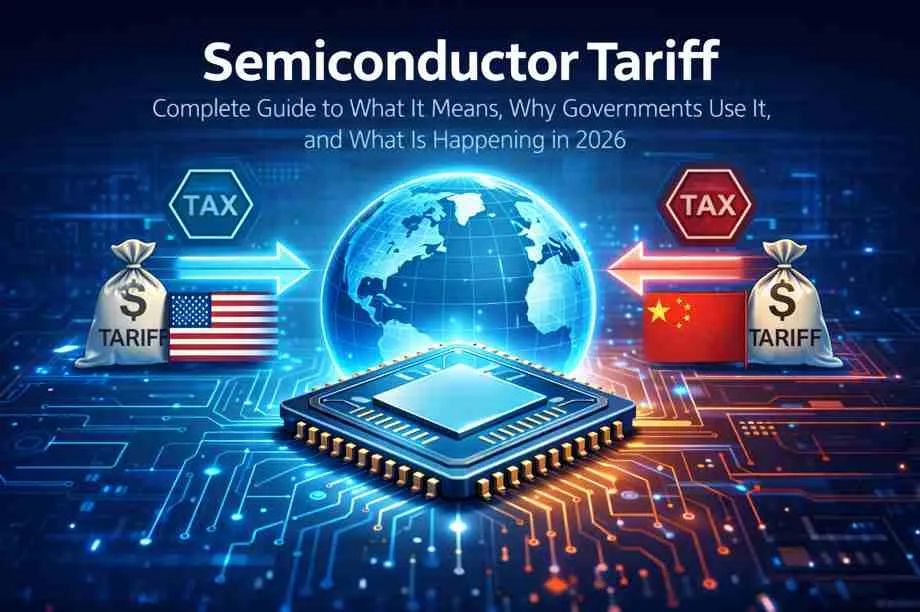


A semiconductor tariff is an import tax placed on chips, chipmaking equipment, or related products. Governments use these tariffs to protect domestic industry, respond to trade dependence, or pursue national security goals. In the United States, semiconductor tariffs became more visible in 2025 and 2026 through Section 232 style national security actions and targeted duties on certain advanced computing chips, though the exact coverage and exemptions matter a lot.
This topic matters because semiconductors are not like ordinary consumer goods. Tariffs on chips can affect everything from AI servers and laptops to cars and industrial systems. That means the real question is not only whether tariffs exist. It is also how they reshape investment, supply chains, prices, and geopolitical strategy.
What a Semiconductor Tariff Means
A semiconductor tariff is simply a tax on imported semiconductor products or related equipment. That can include finished chips, advanced computing chips, semiconductor manufacturing equipment, or even derivative products depending on the policy design. The legal basis can vary, but in the United States recent actions have leaned heavily on national security justification.
In plain English, a tariff makes imported products more expensive at the border. That cost can then be absorbed by the importer, passed on to downstream firms, or pushed partly to consumers depending on the market. In a semiconductor context, the effects can spread widely because chips sit inside so many other products.
So when people ask about semiconductor tariffs, they are not only asking about chip prices. They are asking about a policy tool that can influence manufacturing strategy, investment decisions, supply chain geography, and technology competition at the same time.

Why Governments Put Tariffs on Semiconductors
Governments usually justify semiconductor tariffs in one of three ways. First, they may want to protect or encourage domestic chip manufacturing. Second, they may want to reduce dependence on foreign supply chains for national security reasons. Third, they may use tariffs as leverage in broader trade and industrial policy strategy.
The White House January 2026 fact sheet framed the issue directly in security and industrial terms. It said the tariff action on certain advanced computing chips was intended to protect America’s economic and national security and support domestic semiconductor capacity. That is a classic example of tariffs being used for strategic industry policy, not only for revenue.
This logic fits a larger global trend. Chips are now treated as strategic assets, not only commercial inputs. Once that happens, tariffs start looking less like ordinary customs policy and more like part of a technology security playbook.
What Happened in the United States in 2025 and 2026
The U.S. picture changed sharply in this period. In June 2025, Reuters reported that Republican lawmakers formally asked the Commerce Department to launch a Section 232 national security investigation into semiconductor imports. That was important because Section 232 is the same legal framework long used for steel and aluminum tariffs, and it signaled that chips were moving into the same strategic trade category.
Then in January 2026, the White House issued a proclamation on adjusting imports of semiconductors, semiconductor manufacturing equipment, and derivative products into the United States. The companion fact sheet said the President imposed a 25 percent tariff on certain advanced computing chips such as the NVIDIA H200 and AMD MI325X.
That same White House material also said the tariff would not apply to chips imported to support the buildout of the U.S. technology supply chain and the strengthening of domestic manufacturing capacity for derivatives of semiconductors. This exemption matters because it shows the policy is not a simple flat barrier. It is a targeted tariff with industrial policy carveouts.
Section 232 and Why It Matters for Semiconductor Tariffs
Section 232 is a U.S. legal mechanism used when imports are seen as threatening national security. In the semiconductor context, this matters because it gives tariffs a security rationale rather than a standard protectionist one. Once chips are framed as national security assets, the policy conversation changes fast.
The January 2026 presidential action explicitly treated semiconductors and semiconductor manufacturing equipment as part of this wider security and industrial challenge. It also instructed the Secretary to provide a July 1, 2026 update on the market for semiconductors used in U.S. data centers so the President could decide whether tariff changes were appropriate. That means the policy is still dynamic rather than fully settled.
So if you are looking for the latest status, one important takeaway is this. U.S. semiconductor tariffs in 2026 are not frozen forever. They remain connected to ongoing executive review and market assessment.
| Key issue | What it means |
|---|---|
| Section 232 | Tariffs justified through national security concerns |
| Advanced chip tariff | 25 percent duty on certain advanced computing chips |
| Exemptions | Some imports tied to U.S. supply chain buildout are excluded |
| Ongoing review | Administration may modify tariffs after market updates |
Which Products Can Be Affected
The obvious targets are advanced chips themselves, especially high performance chips tied to AI and data center use. However, the January 2026 presidential action also referenced semiconductor manufacturing equipment and derivative products, which means the broader semiconductor ecosystem can fall under the policy discussion too.
This matters because many firms do not import chips as standalone products. They import servers, boards, systems, tools, and machinery that either contain semiconductors or are used to produce them. A tariff that sounds narrow can still create wider business effects if it touches these surrounding layers.
That is why businesses watch not only the headline rate, but also the annexes, definitions, and exemption language. In semiconductor policy, the exact product scope is often just as important as the tariff number itself.
Potential Benefits Supporters See
Supporters of semiconductor tariffs usually argue that the U.S. cannot afford to stay too dependent on foreign chip production. They say tariffs can encourage local manufacturing, strengthen resilience, and push companies to invest more in domestic fabs, packaging, and related supply chain capacity. The January 2026 White House fact sheet clearly linked the tariff policy to domestic capacity building.
Another argument is leverage. A tariff can be used to pressure firms and trading partners to align more closely with U.S. technology security goals. This is especially relevant when semiconductors are viewed not only as commercial goods but as strategic infrastructure for AI, defense, and advanced computing.
Supporters also argue that selective tariffs are different from blanket tariffs. If exemptions are designed to support U.S. manufacturing buildout, then the tariff can act as a steering mechanism rather than a pure wall. That is the theory behind the 2026 chip tariff carveout language. ([whitehouse.gov]
Potential Costs and Criticisms
Critics usually focus on cost, complexity, and retaliation risk. Tariffs can raise prices for importers and downstream users, especially if domestic alternatives are not ready at scale. In the semiconductor world, that can affect data center operators, cloud providers, electronics makers, and firms relying on advanced computing hardware.
There is also a timing problem. Building semiconductor capacity takes years, not weeks. A tariff can be announced quickly, but factories, equipment ecosystems, skilled labor pipelines, and supplier networks take much longer to create. That means tariffs may hit current costs before domestic capacity can fully respond.
Critics also worry that too many strategic tariffs can fragment the global semiconductor system and create new inefficiencies. Chips rely on highly international supply chains, so trying to force too much localization too fast can create its own bottlenecks.
How Semiconductor Tariffs Affect Prices
In principle, a tariff increases the landed cost of the imported product. Whether that turns into higher end prices depends on competition, inventory, contract terms, substitution options, and how important the chip is inside the final product. However, semiconductors often sit deep inside long supply chains, so even a targeted tariff can ripple outward.
If the tariff hits a high value advanced chip used in AI servers, the direct effect may be strongest in data centers and enterprise hardware rather than in low end consumer electronics. If equipment or derivative products are hit too, the impact can widen. That is why tariff design matters as much as tariff existence.
Exemptions can partly soften the blow. The White House specifically said the 25 percent tariff would not apply to chips imported to support U.S. technology supply chain buildout. That means some firms tied directly to domestic manufacturing expansion may not face the same cost burden. ([whitehouse.gov]
Semiconductor Tariffs and Taiwan
One major geopolitical angle involves Taiwan. In February 2026, USTR published a fact sheet on a U.S.-Taiwan reciprocal trade understanding that said the U.S. side would provide Taiwan preferential treatment with regard to tariffs and other remedial measures in the Section 232 semiconductor investigation, taking into account Taiwan’s economic and national security alignment and strategic partnership with the United States.
This matters because Taiwan plays a central role in the global semiconductor ecosystem. A tariff regime that ignores Taiwan’s role could create major disruption. The USTR language suggests the U.S. is trying to balance industrial security concerns with strategic partner management rather than treating every semiconductor source exactly the same.
So another key lesson is that semiconductor tariff policy is not only about products. It is also about alliances, strategic trust, and the political ranking of supplier countries.
| Main question | Short answer |
|---|---|
| Are there U.S. semiconductor tariffs in 2026 | Yes, including a 25 percent tariff on certain advanced computing chips |
| Are all chips treated the same | No, product scope and exemptions matter a lot |
| Is the policy final forever | No, the White House ordered further review in 2026 |
| Are allies treated identically | No, Taiwan received stated preferential treatment in related trade arrangements |
What Businesses Should Watch
Businesses should watch three things closely. First, the exact tariff coverage list. Second, the exemption rules tied to domestic supply chain buildout. Third, the next federal review milestones, especially the July 2026 update ordered by the January proclamation. Those details can change the cost and compliance picture quickly.
They should also watch country specific trade arrangements. The Taiwan fact sheet shows that semiconductor tariff policy is not operating in a vacuum. Strategic partners may receive more favorable treatment, which can reshape sourcing decisions.
In practice, this means semiconductor tariff policy is now part customs issue, part industrial policy, and part geopolitical map. Any company in chips, servers, AI hardware, semiconductor equipment, or downstream electronics needs to read it that way.
Conclusion
Semiconductor tariff now means much more than a tax on imported chips. In the United States, it has become part of a broader strategy around national security, AI competition, supply chain resilience, and industrial policy. The most important current facts are that the White House imposed a 25 percent tariff on certain advanced computing chips in January 2026, created exemptions tied to domestic supply chain buildout, and left the door open for policy adjustments after further review.
The best way to understand semiconductor tariffs is not as a simple yes or no policy. It is a layered strategy shaped by product type, national security framing, allied relationships, and industrial goals. If you track those layers instead of just the headline rate, the whole picture becomes much clearer.