
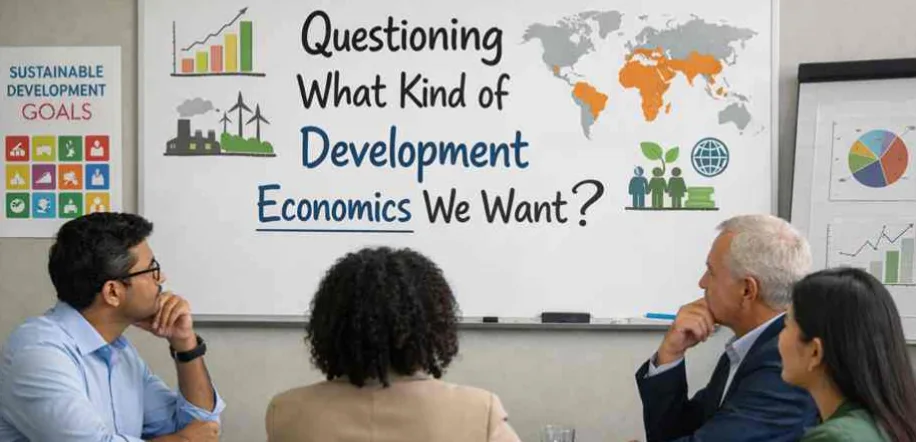


The development economics we want should care about more than GDP growth alone. It should ask whether growth reduces poverty, expands freedom, builds resilience, protects the planet, strengthens local institutions, and gives ordinary people real chances to live better lives.
For a long time, development economics was often treated like a technical project. Raise productivity, expand markets, increase investment, and growth will do the rest. However, real life keeps reminding us that growth by itself does not answer every important question. A country can grow while inequality deepens. It can industrialize while communities are displaced. It can attract investment while workers stay insecure. Therefore, the more honest question is not just how to develop, but what kind of development we actually want.
Why This Question Matters So Much
Development economics shapes real decisions. It influences what governments fund, what international lenders support, what donors measure, and what institutions call success. When the framework is narrow, the policies often become narrow too.
If we treat development as nothing more than raising average income, we may ignore who remains excluded. If we treat it only as market expansion, we may overlook public health, education, care work, and ecological survival. That is why this question matters. It changes what we count, what we reward, and what we are willing to protect.
The World Bank has long emphasized inclusive growth as growth that allows people to contribute to and benefit from economic expansion. That idea already pushes the conversation beyond simple aggregate growth. It reminds us that the pattern of growth matters, not just the pace of it.
Development Economics Was Never Only About Numbers
Even though many people think of economics as numbers first, development economics has always had a moral side. It asks how societies change, how poverty can be reduced, how opportunity can expand, and how people can gain more control over their own lives.
That is one reason this field can never be fully neutral. The moment we ask what counts as development, we are already making a value judgment. Are we talking about rising national income. Are we talking about human freedom. Are we talking about equality. Are we talking about sustainability. The answer shapes the entire framework.
Amartya Sen’s capability approach helped make this point much clearer. The human development tradition associated with UNDP argues that development should be understood in terms of expanding people’s capabilities, choices, and freedoms, not only increasing income. That shift matters because it places human lives at the center instead of treating them as side effects of growth.
Do We Want Growth First, Or Human Well Being First
This is one of the biggest debates inside development thinking. One view says growth must come first because without a growing economy, there is not enough wealth to support schools, hospitals, infrastructure, and jobs. There is truth in that. Poor countries need growth, investment, and productivity gains. Pretending otherwise does not help anyone.
However, another view says the order cannot be so simple. If growth happens without broad access to health, education, nutrition, safety, and social inclusion, then many people may never be in a position to participate in growth fairly. In that sense, human development is not only the result of growth. It is also one of the conditions that make better growth possible.
This is where the question becomes more interesting. Maybe the development economics we want should stop pretending that growth and human well being are rival goals. Maybe it should ask how to make them reinforce each other instead of sacrificing one to the other.
What Happens When GDP Becomes the Main Story
GDP matters. It tells us something important about economic activity. It helps governments and researchers compare output over time. It is useful. However, it becomes dangerous when it turns into the whole story.
A country can post strong GDP growth while unemployment stays high for some groups. It can grow while informal work remains insecure. It can grow while women do unpaid care work that never appears properly in the statistics. It can grow while environmental damage quietly piles up in the background.
That is why many critics argue that GDP should be treated as one indicator, not the moral scoreboard for development. When it becomes the only headline, many human realities disappear from view.
| What GDP shows | What GDP can miss |
|---|---|
| Overall economic output | Distribution of gains |
| Growth over time | Unpaid care work |
| Market activity | Environmental damage |
| National production trends | Freedom, dignity, and security |
Do We Want Development That Is Inclusive
Inclusive development sounds like an obvious goal, but it is harder than it sounds. It means growth should not remain concentrated in one class, one region, or one type of worker. It means people should have a fair chance to benefit from economic change, not just watch it happen around them.
The World Bank’s work on inclusive growth stresses that rapid growth is necessary for major poverty reduction, but it also says growth should be broad based across sectors and create productive employment. That is important because inclusion is not only about handing out benefits after growth happens. It is also about designing the growth process itself more fairly.
When we ask what kind of development economics we want, inclusion should be near the center. A model that generates wealth while leaving millions trapped in precarity is not neutral. It reflects a choice.
Do We Want Development That Respects the Planet
Older development models often treated environmental damage as an unfortunate side issue that could be handled later. That logic is much harder to defend now. Climate risk, biodiversity loss, water stress, extreme heat, and pollution are no longer side notes. They shape the real future of development.
The United Nations Sustainable Development Goals clearly present development as something that must combine prosperity with environmental protection. That matters because it rejects the old idea that countries must choose between human progress and planetary survival. In reality, development that destroys the conditions for future life is not lasting development at all.
So the development economics we want must take sustainability seriously from the start, not as a decorative add on after the growth model is already locked in.
Do We Want Development Led From Above, Or Built From Below
Another major question is where development ideas come from. Too often, policy models are exported from outside and applied as though all countries face the same institutional history, social structure, and political reality. That can produce tidy reports and messy outcomes.
Real development is local as well as global. Institutions matter. History matters. Land systems matter. Gender norms matter. State capacity matters. A policy that works in one context may fail badly in another. That does not mean countries should reject global learning. It means development economics should respect local knowledge instead of treating people as empty spaces waiting for external expertise.
The development economics we want should be more humble about templates and more serious about context. Otherwise, it risks becoming an elegant language for repeating the same mistakes.
Do We Want Structural Transformation, And At What Cost
Structural transformation remains a core development idea. Countries often grow when labor and capital move from lower productivity activities into higher productivity sectors such as manufacturing, modern services, and more efficient agriculture. This shift can matter a lot for wages, productivity, and long term national capacity.
But structural transformation also raises hard questions. Who is displaced when sectors change. What happens to rural communities. What kind of jobs are being created. Are they secure, dignified, and productive, or simply new forms of vulnerability. Growth can be real while the social experience of that growth remains fragile.
So yes, development economics should still care about transformation. But it should also care about the quality of the transition, not only the output gains on paper.
Do We Want Development That Reduces Inequality
Many development debates used to focus more directly on poverty than inequality. Poverty remains essential, of course. However, inequality matters too because it affects power, access, bargaining strength, social trust, and long term stability.
The United Nations states plainly that inequality threatens long term social and economic development and harms poverty reduction. That is a powerful reminder that distribution is not a side issue. A society can reduce extreme poverty somewhat while still reproducing deep unfairness in who has voice, assets, mobility, and security.
The development economics we want should take inequality seriously not only because inequality feels morally troubling, but because it shapes how development actually works in practice.
| Development goal | Question we should ask |
|---|---|
| Growth | Who benefits, and who is left out |
| Transformation | What kinds of jobs and security are created |
| Sustainability | Can this path last without environmental breakdown |
| Inclusion | Do ordinary people gain real access and agency |
| Policy reform | Does it fit the local institutional reality |
Should Development Economics Care More About Freedom
This is one of the most important shifts in modern thinking. If development is not only about income, then it must ask what people are actually free to do and to become. Can they get educated. Can they move safely. Can they participate in decisions. Can they access health care. Can they live without constant fear and humiliation.
The capability approach matters here because it changes the question from what people have to what they are genuinely able to do with their lives. That is a deeper standard. Two people may have similar incomes, but very different real freedoms depending on health, discrimination, location, gender, safety, and public services.
So the development economics we want should probably care much more about substantive freedom than older narrow models often did.
Why Institutions Still Matter
There is no serious development economics without institutions. Markets need rules. Property needs enforcement. Contracts need trust. Public services need competence. Even the best development goals collapse when institutions are weak, extractive, or captured by narrow interests.
However, institutional talk can also become too abstract. It is not enough to say institutions matter. We need to ask which institutions, for whom, under what political conditions, and with what accountability. Institutions are not neutral machines. They reflect power and priorities.
This is why development economics should care about state capacity and democratic accountability together. A capable state without accountability can become predatory. Accountability without capacity can become performative. Development needs both.
What Kind of Development Economics Do We Want Then
We probably want a development economics that is more human, more democratic, more ecological, and more honest about tradeoffs. We want one that still cares about growth, because poor societies do need rising productivity and material improvement. But we do not want growth treated as a moral shortcut that excuses everything else.
We want a development economics that asks whether people are healthier, safer, freer, and more secure. We want one that respects local context instead of forcing every country through the same policy script. We want one that sees women’s labor, environmental limits, institutional quality, and inequality as central questions, not side issues.
Most of all, we want a development economics that treats development as something done with people, not to them.
Conclusion
Questioning what kind of development economics we want is not a distraction from real policy. It is the starting point for better policy. Once we stop asking only how to grow and start asking who benefits, what is sustained, what freedoms expand, and what forms of injustice remain, the field becomes much more useful.
The development economics we want should still care about investment, productivity, jobs, and structural change. However, it should also care just as deeply about dignity, inclusion, ecological survival, and real human capability. If development does not make life broader, safer, and more liveable for ordinary people, then it may be growth, but it is not enough.