
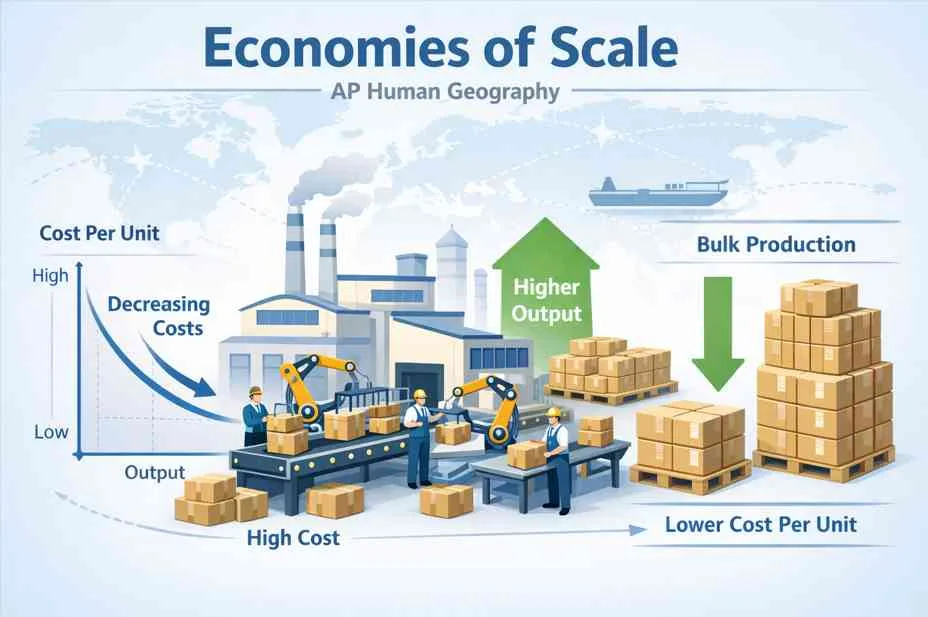


In AP Human Geography, economies of scale means a business, farm, or industry can produce goods more cheaply per unit when it operates on a larger scale. This matters because it helps explain why large factories, industrial clusters, agribusiness, and trade networks often become more competitive than smaller producers.
This concept sounds like pure economics, but it is also geographic. Economies of scale helps explain why certain places attract industry, why some farms become very large, and why global trade often favors regions that can produce huge amounts efficiently. That is why AP Human Geography uses it in real world location and development questions, not just in theory.
What Economies of Scale Means
Economies of scale means the average cost of producing something falls as production increases. Britannica explains it as the relationship between the size of a plant or industry and the lowest possible cost of a product, noting that when output rises, average cost often falls.
In plain English, big operations often become cheaper per unit than small ones. A factory making one thousand shoes may spend more per shoe than a factory making one hundred thousand shoes. The large factory can spread costs across more products, buy in bulk, use better machines, and organize labor more efficiently.
That does not mean bigger is always better forever. It means that, up to a point, increasing scale can create lower costs and stronger competitive advantage. AP Human Geography mainly uses the concept to explain why large scale production often changes location patterns, labor systems, and economic relationships across space.

Why Economies of Scale Matters in AP Human Geography
AP Human Geography is not only about memorizing maps. It is about understanding spatial patterns. Economies of scale helps explain why economic activity tends to cluster, why some firms dominate markets, and why production often shifts toward places that can support large scale operations.
For example, if transportation networks improve, companies may ship goods more cheaply and produce on a larger scale. College Board scoring commentary for AP Human Geography explicitly linked affordable transportation and large commodity movement to economies of scale in agricultural production.
This means the concept connects directly to industrial location, agriculture, globalization, and even trade agreements. It is useful because it turns a simple cost idea into a geographic explanation for why some places grow economically while others lose production.
Simple Definition You Can Use on the Exam
If you need a short AP style definition, use this. Economies of scale are cost advantages gained when production increases, causing the average cost per unit to fall. That is short, accurate, and easy to apply in a free response answer.
You can make the definition stronger by adding a geographic point. For example, larger farms, factories, or firms can produce more efficiently, which helps explain why production often concentrates in certain regions or companies. That extra layer makes your answer more human geography focused instead of sounding like a generic economics sentence.
On an exam, the strongest answers usually define the concept clearly and then apply it to a real example such as dairy farms, global manufacturing, or trade blocs. College Board scoring examples show that this application step is often what earns the point.
How Economies of Scale Works
There are several reasons scale lowers cost. One reason is bulk buying. Large producers can buy raw materials in bigger quantities and often pay less per unit. Another reason is specialization. Bigger operations can divide work more efficiently and use workers or managers in narrower, more productive roles. Investopedia and Britannica both point to specialization and bulk purchasing as major sources of scale advantage.
Technology also matters. A large factory may afford advanced machines that a small producer cannot justify. Once those machines are running, they can spread fixed costs over far more output. This lowers average cost and often makes the big producer more competitive.
Marketing and transport can work the same way. A large company can spread advertising, logistics, and management costs over more products. In AP Human Geography, that helps explain why large firms often dominate industries and why improved infrastructure can strengthen large scale production systems.
| Source of economies of scale | How it lowers cost |
|---|---|
| Bulk purchasing | Large firms buy inputs more cheaply |
| Specialization | Workers and managers become more efficient |
| Technology | Machines spread cost across more output |
| Transportation | Large shipments lower cost per unit |
| Marketing and administration | Fixed costs are spread over more goods |
Economies of Scale in Agriculture
This is one of the most useful AP Human Geography applications. Large farms often benefit from economies of scale because they can buy machinery, fertilizer, and seeds in larger quantities, use transport more efficiently, and produce for wider markets. That is why commercial agriculture often becomes dominated by large operations.
College Board materials directly connected economies of scale to large scale dairy farming. When farms can move large amounts of product efficiently, they often reduce average cost and become more competitive than smaller farms. This is a strong example for FRQs because it combines agriculture, transportation, and scale in one clear case.
However, this can also create uneven effects. Large agribusiness operations may push smaller farmers out or make it harder for local farms to compete. That means economies of scale can help explain both agricultural efficiency and agricultural inequality. That is a great human geography angle because it shows that space and power both matter.

Economies of Scale in Industry
In industry, economies of scale helps explain why manufacturing often concentrates in large plants and industrial regions. A big automobile plant, steel factory, or electronics producer can often lower costs more effectively than a small workshop. That makes large scale industrial production a major feature of modern economic geography.
This also connects to industrial location theory. Firms may choose locations where transport is cheap, labor is available, and supporting industries are nearby. Once a region builds that advantage, large scale production can become even more efficient there. The result is clustering, which is a major theme in AP Human Geography.
That means economies of scale is not just about one factory. It can help explain why whole industrial regions become powerful. When many connected firms benefit together, the effect becomes geographic, not only economic.
Internal vs External Economies of Scale
This distinction is useful if you want a stronger answer. Internal economies of scale happen inside a single company. For example, one firm becomes more efficient because it gets bigger, buys more inputs, or uses better technology. That is the basic version most students learn first.
External economies of scale happen when an entire industry or location becomes more efficient. Investopedia explains that external economies of scale apply to an entire industry rather than one company. For example, if a city improves transport for a manufacturing sector, all the firms in that area may benefit.
This external version is especially useful in human geography because it connects directly to agglomeration, infrastructure, and regional development. It helps explain why businesses often cluster near one another and why location can lower cost even if a single firm does not change much by itself.
Economies of Scale and Globalization
Economies of scale also helps explain globalization. When firms can produce goods cheaply at very large scale, they can serve markets far beyond their local area. That encourages international trade, global commodity chains, and large manufacturing hubs. Britannica notes that economies of large scale production help explain why economically similar countries still trade heavily with each other.
AP Human Geography often connects globalization to changes in production and transportation. Large firms use global shipping, containerization, and trade networks to lower costs further. This means economies of scale can operate not only inside one factory but across international supply chains.
This is one reason multinational corporations become so powerful. They combine scale, specialization, and global reach in ways that smaller firms often cannot match. That has major geographic effects on labor, trade, and development patterns.
Economies of Scale and Supranational Organizations
This concept also appears in political and economic integration. College Board scoring guidelines accepted “to create economies of scale” as a purpose of supranational organizations. That is a very useful AP connection. It means groups of countries can cooperate to increase production, lower costs, and become more competitive together.
For example, a trade bloc can make it easier for firms to access a larger market, standardize production, and spread costs across more consumers. That can encourage firms to operate at a larger scale than they could in one national market alone.
On the exam, this gives you another application beyond factories and farms. Economies of scale can help explain why countries join economic organizations, not just why firms become larger. That is a great example of how AP Human Geography links economic concepts to political geography.
| AP Human Geography topic | How economies of scale fits |
|---|---|
| Agriculture | Large farms lower unit costs and outcompete smaller farms |
| Industry | Large factories and industrial clusters reduce costs |
| Globalization | Multinational firms use scale to supply world markets |
| Transportation | Cheap large scale movement lowers production costs |
| Supranationalism | Larger combined markets create scale advantages |
Limits of Economies of Scale
It is also important to know that economies of scale does not continue forever. At some point, very large operations can become harder to manage. Costs may rise because of bureaucracy, coordination problems, transportation complexity, or inefficiency. Economists sometimes call this diseconomies of scale.
This matters in geography because bigger is not always automatically better. A giant operation may lower costs at first, but later become less flexible or more fragile. That is useful when thinking about why some firms stay large while others break up or relocate.
For the AP exam, you usually do not need a deep technical explanation here. Still, it helps to remember that economies of scale is a tendency, not a permanent law with no limits.

How to Use This in an FRQ
On an FRQ, do not just define economies of scale and stop. Define it, then connect it to a process or place. For example, you could say that large commercial dairy farms benefit from economies of scale because transportation and bulk production reduce the average cost per unit, making them more competitive than smaller farms. That type of applied answer is exactly what College Board commentary rewards.
You can also apply it to industry by saying that large factories or clustered industries lower production costs through specialization, technology, and infrastructure. Or apply it to trade blocs by saying larger combined markets create economies of scale for member states and firms.
The key is simple. Define, explain, and apply. That three step structure usually makes your answer stronger and more AP ready.
Common Mistakes Students Make
One common mistake is confusing economies of scale with just making more money. It is not about profit alone. It is about lowering average cost per unit as production increases. Another mistake is giving a definition with no real example. On AP Human Geography, application matters a lot.
A third mistake is treating the concept like it only belongs in industry. It also appears in agriculture, transportation, trade, and supranational organizations. That wide use is exactly why it is such a valuable term to understand well.
Finally, some students use the term too vaguely. The strongest answers always connect it to lower per unit cost and explain why size creates that effect.
Conclusion
Economies of scale AP Human Geography is a key concept because it helps explain why large scale production often becomes cheaper and more competitive. In simple terms, as production increases, average cost per unit often falls. That idea helps explain patterns in agriculture, industry, transport, trade, and globalization. College Board materials directly use this concept in examples involving dairy farming and supranational organizations, so it is very much an AP Human Geography term, not just a general economics idea.
The smartest way to remember it is this. Bigger production can lower cost, and that changes where economic activity happens. If you can define that clearly and connect it to a real geographic example, you will be in a strong position for the exam.