
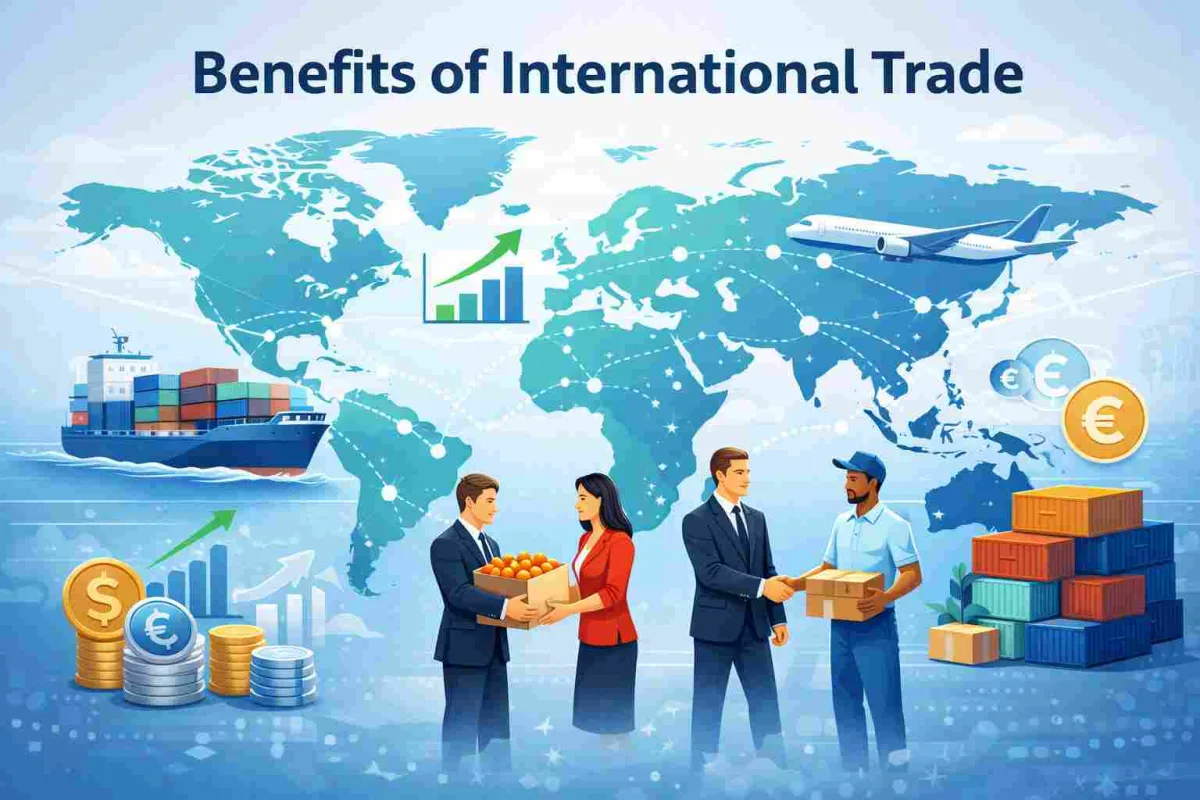


The main benefits of international trade include lower prices for consumers, more variety of goods and services, access to inputs and products countries cannot produce efficiently on their own, stronger specialization, higher productivity, larger export markets for firms, and faster economic growth when countries connect well to global value chains. The IMF, World Bank, and WTO all describe trade as helping productivity, growth, competition, and consumer welfare.
That does not mean trade helps everyone equally in every moment. Trade creates winners and losers inside countries, and that is one reason it becomes politically controversial. However, if the question is asking what the major benefits are, there is a clear core list that appears again and again in authoritative sources.
What International Trade Means First
International trade means buying and selling goods and services across national borders. Countries export things they produce and import things made elsewhere. The IMF describes international trade as commerce among nations, where countries trade because they can produce different goods efficiently or gain from exchanging with others.
This sounds simple, but the effects are very broad. Trade changes what consumers can buy, what firms can produce, where factories locate, how supply chains operate, and how countries grow. That is why international trade is one of the most important topics in economics and development policy.
So when a question asks which of the following are benefits of international trade, it is really asking about the practical results of countries opening up to exchange more with each other.
Benefit 1, Lower Prices for Consumers
One of the clearest benefits of international trade is lower prices. When countries trade more openly, consumers can buy goods from more sources, and competition usually increases. The IMF, World Bank, and WTO all emphasize that trade can reduce prices by increasing competition and access to cheaper goods.
The IMF and its partner institutions specifically say that trade makes a wider variety of goods and services accessible at lower prices, and they note that this can especially help lower income households because cheaper everyday goods raise real purchasing power.
This is one reason multiple choice questions often include “lower prices for consumers” as a correct answer. It is one of the most standard and widely accepted benefits of international trade.
Benefit 2, More Variety of Goods and Services
Another major benefit is greater product variety. The IMF explains that trade results not only in more products, but in greater product variety. It gives the example that the United States imports many more varieties of goods than in earlier decades.
This matters because people do not only value lower prices. They also value more choices. Trade lets consumers buy different kinds of food, electronics, clothing, medicines, and services that may not be available or affordable if the domestic market stays more closed.
So if your question includes “greater variety of goods and services,” that is also a classic benefit of international trade.
Benefit 3, Specialization and Comparative Advantage
Trade allows countries to specialize more in what they do relatively well. This idea is closely tied to comparative advantage. Instead of every country trying to make everything, countries can focus more on products or services where they are more efficient and trade for the rest.
That specialization can lower costs and raise total output. Even if one country is strong in many industries, trade can still help by encouraging firms to concentrate on what they do best and exchange for what others produce more efficiently.
This is why “specialization” is one of the most important trade benefits to remember for school and exam questions. It is one of the basic building blocks of international trade theory.
Benefit 4, Higher Productivity
International trade can raise productivity. The World Bank says trade leads to faster productivity growth, especially for sectors and countries engaged in global value chains. The IMF also notes that lowering trade barriers can revive productivity and growth.
This happens for several reasons. Trade increases competition, encourages firms to improve, gives access to better inputs, and pushes resources toward more productive businesses. The IMF and World Bank materials both point to these kinds of channels.
So if one of the answer choices says trade improves productivity or efficiency, that is also a strong benefit supported by major institutions.
| Benefit of trade | Why it happens |
|---|---|
| Lower prices | More suppliers and more competition |
| More variety | Access to products from many countries |
| Specialization | Countries focus more on what they do efficiently |
| Higher productivity | Firms face competition and gain better inputs |
| Bigger markets | Businesses can sell beyond their home country |
Benefit 5, Larger Markets for Businesses
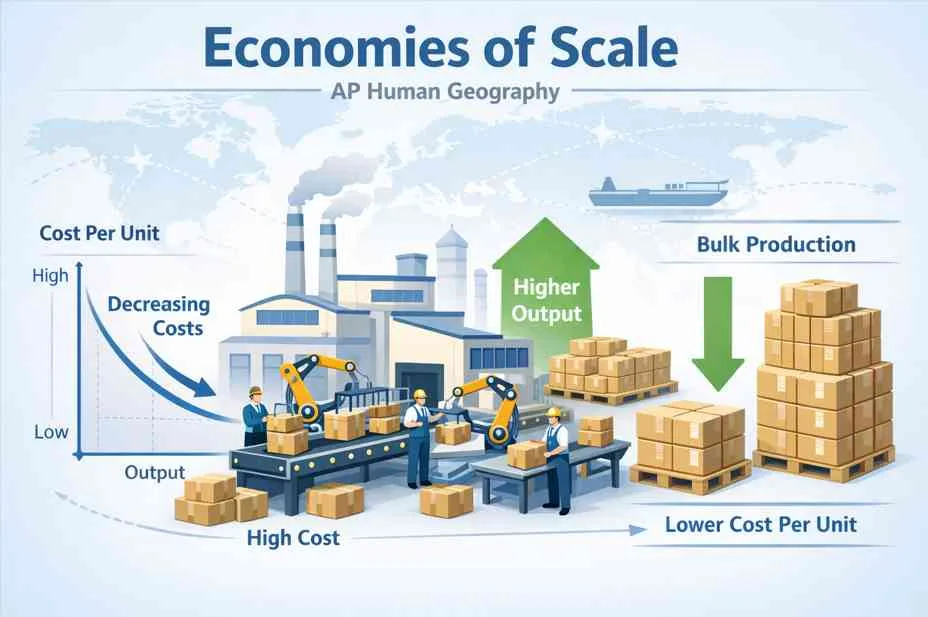
Trade gives businesses access to bigger markets. Instead of selling only to domestic consumers, firms can export to customers abroad. That larger market can help firms expand production, spread fixed costs, and invest more in innovation and efficiency.
The WTO paper on trade, growth, and product innovation highlights the role of market size in giving firms stronger incentives to innovate and produce a larger range of goods. That means trade can support growth not just by selling more, but by changing what firms are willing to create and improve.
This is why export access is a major benefit of trade, especially for firms in smaller domestic economies. Bigger markets can change the whole scale of opportunity.
Benefit 6, Stronger Competition and Better Quality
Trade increases competition. The WTO says that with stability and predictability, investment is encouraged, jobs are created, and consumers enjoy the benefits of competition, including choice and lower prices. Older WTO material also stresses that international trade can help prevent domestic firms from maintaining closed, less competitive markets.
When firms face foreign competition, they often have stronger reasons to improve quality, lower costs, and innovate. Without that pressure, protected firms may become less efficient and less responsive to consumers.
So if your answer choices include improved competition or better quality, those are also valid benefits of international trade.
Benefit 7, Access to Better Inputs and Technology
Trade helps firms get access to imported raw materials, components, machinery, and technology that may be better or cheaper than domestic alternatives. The IMF and World Bank trade paper says trade makes available a wider range of intermediate production inputs, lowering firms’ costs.
This is a major benefit for modern supply chains. A country does not need to produce every part of every product by itself. Firms can import what they need, combine it with domestic strengths, and produce more competitively.
That means international trade supports not only final consumer goods, but also the hidden building blocks of production. If your question mentions access to raw materials, better inputs, or technology, those are important trade benefits too.
Benefit 8, Economic Growth and Development
The World Bank says trade has been a powerful driver of economic development and poverty reduction. It also says trade leads to faster productivity growth and can support better jobs and stronger integration into global value chains.
The WTO annual report summary likewise says trade and globalization have brought enormous benefits to many countries and citizens. These benefits do not show up automatically or evenly, but at a broad level trade is strongly linked to growth and long term development in many economies.
This is why economic growth is another common correct answer in trade questions, although it is best understood as a broad long term effect rather than something guaranteed in every short term situation.
Benefit 9, Job Creation in Export Sectors
Trade can create jobs, especially in export oriented sectors and connected supply chains. The WTO says investment is encouraged and jobs are created when trade rules are stable and predictable. The World Bank also links productivity and trade to more and better jobs in its recent regional reporting.
However, this benefit needs nuance. Trade can also displace jobs in sectors that face import competition. So the honest answer is not that trade creates jobs everywhere in exactly the same way. It creates opportunities in some sectors while putting pressure on others. Still, job creation in export industries is a real and standard benefit.
In a multiple choice setting, if the option says something like “creates jobs in export industries,” that is much more accurate than a sweeping claim that trade benefits every worker equally.
Why Trade Benefits Lower Income Households To
This point often gets overlooked, but the IMF, WTO, and World Bank paper specifically notes that lower prices and wider product access from trade tend to benefit lower income households because those households spend a larger share of their income on everyday goods.
The WTO work on trade costs and inclusive growth also explains that high trade costs keep consumers from accessing competitively priced goods from abroad and that lower trade costs are typically associated with poverty reduction.
That means one benefit of trade is not just abstract efficiency. It can directly affect real household living standards, especially through the prices of essential goods.
| Likely correct trade benefit | Why it is correct |
|---|---|
| Lower consumer prices | Trade expands competition and access to cheaper goods |
| More product variety | Consumers can buy from more countries and suppliers |
| Specialization | Countries and firms focus on what they do relatively well |
| Higher productivity | Trade pressure and better inputs make firms more efficient |
| Larger markets for firms | Exports expand demand beyond domestic buyers |
| Access to inputs and technology | Imports help production become cheaper and better |
| Growth and development | Trade is linked to productivity, income, and poverty reduction |
What Is Usually Not a Benefit of International Trade
If you are answering a test question, it also helps to know what is usually not listed as a trade benefit. Statements such as “trade always protects domestic jobs,” “trade removes all inequality,” or “trade always helps every industry equally” are usually wrong or too absolute. The WTO’s 2024 trade and inclusiveness report makes clear that the benefits of trade need to be widely distributed and supported by complementary policies.
Trade brings real benefits, but it does not automatically make all outcomes fair. Some industries lose protection. Some workers face adjustment costs. Some regions gain more than others. This does not erase the benefits, but it does mean you should watch for extreme answer choices that sound too perfect.
So in multiple choice questions, broad positive statements like lower prices or more variety are usually safer than sweeping claims that trade helps everyone in exactly the same way.
How to Answer This on a Test
If you get a question that says “Which of the following are benefits of international trade,” look for answer choices that mention lower prices, more choice, specialization, higher productivity, access to inputs, export opportunities, or growth. Those are the standard benefits most textbooks and institutions agree on.
Be careful with answers that use words like always, only, or all. Trade does not eliminate every problem, and it does not help every group in the same way at the same time. The best answers usually describe core economic benefits without pretending trade is perfect.
If the question lets you select multiple answers, the strongest choices are usually lower prices, more variety, specialization, competition, productivity, and access to larger markets.
Conclusion
Which of the following are benefits of international trade. The best answers usually include lower prices, more variety of goods and services, stronger specialization, higher productivity, access to imported inputs and technology, larger export markets, more competition, and long term support for growth and development. The IMF, World Bank, and WTO all describe these as major gains from trade openness.
If you are preparing for a test, remember the simple rule. Trade usually helps by making markets bigger, goods cheaper, choices wider, and production more efficient. That will usually point you toward the correct options much faster than trying to memorize one rigid sentence.