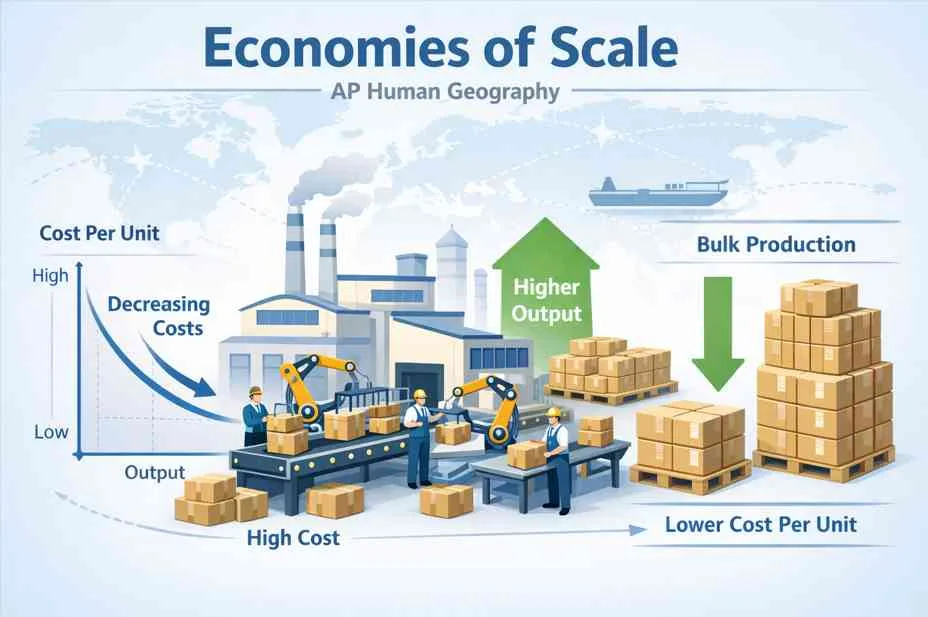




The main advantages of absolute advantage are higher efficiency, lower production costs, greater output, better use of resources, stronger trade opportunities, and the ability to specialize in what a country or producer does best. When producers focus on goods they can make more efficiently, total production can increase and trade can benefit both sides.
This concept matters because it helps explain why specialization can raise overall production. It also connects to international trade, business competition, and economic growth. However, to really understand the advantages, it helps to break the idea down step by step.
What Absolute Advantage Means
Absolute advantage means a producer can make more of a good using the same amount of resources, or make the same amount using fewer resources than another producer. The producer could be a person, a company, or a country. The key point is simple efficiency.
For example, if one country can produce ten tons of wheat with the same labor and land that another country uses to produce six tons, the first country has an absolute advantage in wheat. It is simply better at producing that good in direct physical terms.
This is different from comparative advantage, which focuses on lower opportunity cost rather than raw efficiency. Absolute advantage is about who can produce more or use fewer inputs in a straightforward way.

Why Absolute Advantage Matters
Absolute advantage matters because it helps show where production can happen most efficiently. If one producer is clearly better at making a good, it often makes sense for that producer to specialize more in it. That can lower waste and raise total output.
It also matters because economies do not have unlimited resources. Labor, capital, land, and time all have limits. When those limited resources are used where they are most productive, the economy often performs better overall.
This is why the concept appears so often in economics classes. It gives a simple first step into understanding specialization, trade, and efficiency before moving into more advanced ideas like comparative advantage.
Advantage 1, Higher Efficiency
The most obvious advantage of absolute advantage is higher efficiency. If a country or firm can make more with the same inputs, then it is using resources more effectively. That means less waste and better performance.
Efficiency matters because it helps producers get more value from the resources they already have. Instead of needing extra labor, land, or capital to increase output, a producer with absolute advantage already has a stronger production position.
In practical terms, this can mean faster production, lower effort per unit, and a stronger ability to meet demand without overusing resources.
Advantage 2, Lower Production Costs
When a producer has absolute advantage, production often costs less per unit. That is because fewer resources are needed to create the same product, or the same resources create more output. Lower cost is one of the biggest economic benefits of stronger productivity.
Lower production costs can improve profits for firms or create room for lower prices in the market. In international trade, this can make exports more competitive and give producers a stronger position against foreign rivals.
This does not mean every efficient producer automatically wins forever. However, lower cost is a major structural advantage in most markets.
| Advantage | How it helps |
|---|---|
| Higher efficiency | More output from the same resources |
| Lower cost | Fewer resources needed per unit |
| Specialization | Focus on the goods produced best |
| Trade benefits | Allows exchange with others for mutual gain |
| Greater output | Raises total production in the economy |
Advantage 3, Greater Total Output
Another key advantage of absolute advantage is that it can raise total output. If producers focus more on goods they make efficiently, the total amount produced across the economy can increase. That means more goods are available for consumption, trade, or investment.
This matters because economic growth often depends on producing more value with the resources available. A stronger producer can help increase supply without requiring the same level of additional resource use.
In simple terms, absolute advantage can help an economy get bigger results from the same resource base.
Advantage 4, Better Resource Allocation
Resources work best when they are placed where productivity is highest. Absolute advantage helps guide this process. If a country is especially strong in one type of production, shifting more resources there may create better returns.
This can improve the overall structure of production. Instead of spreading resources too thin across areas where performance is weak, the economy can direct effort toward areas of proven strength.
That does not mean every economy should produce only one thing. However, knowing where absolute advantage exists can improve decision making and reduce inefficient production choices.

Advantage 5, Supports Specialization
Absolute advantage makes specialization easier to justify. If a producer is clearly better at making a good, it often makes sense to focus more on that good rather than dividing effort evenly across many weaker activities.
Specialization can improve skills, speed, and production systems over time. The more a producer focuses on what it does best, the more it can refine processes and improve output further. That can strengthen the original advantage even more.
This is why specialization and absolute advantage are closely connected. The advantage identifies strength, and specialization helps turn that strength into greater results.
Advantage 6, Creates Trade Opportunities
Absolute advantage can create strong trade opportunities. If one country is better at producing one product and another country is better at producing a different product, both can gain by specializing and trading with each other.
Trade allows each side to enjoy goods it does not produce as efficiently itself. Instead of forcing every country to make everything at a weaker level, specialization plus trade can improve access, lower costs, and raise total welfare.
This is one reason trade theory starts with these production concepts. They help explain why exchange between different producers can be beneficial rather than harmful by default.
Advantage 7, Stronger Competitive Position
A producer with absolute advantage often has a stronger competitive position in the market. Higher productivity and lower cost can make it easier to compete at home and abroad. This can help a firm gain market share or help a country build strong export industries.
Competition matters because markets often reward producers who can offer better prices, stronger supply reliability, or larger output. Absolute advantage supports those strengths by improving the basic production foundation.
That said, competition is affected by more than just productivity. Quality, branding, logistics, policy, and market access also matter. Still, raw production advantage remains a major strength.
Advantage 8, Can Support Economic Growth
When absolute advantage improves efficiency, lowers costs, and raises output, it can also support economic growth. More productive sectors can create jobs, raise income, increase trade revenue, and strengthen investment capacity.
At the national level, industries with strong production advantages can become growth engines. They may attract capital, improve export earnings, and help governments collect more tax revenue from expanding economic activity.
This is why production strength is not only a business issue. It can shape the broader path of national development too.
| Area | Benefit of absolute advantage |
|---|---|
| Business | Lower costs and stronger market position |
| Trade | Better export opportunities |
| Consumers | Potentially lower prices and more supply |
| Economy | Higher productivity and possible growth |
Real World Example of Absolute Advantage
Imagine Country A can produce 100 units of coffee or 50 units of steel with a set amount of labor. Country B can produce 60 units of coffee or 30 units of steel with the same labor. Country A has absolute advantage in both goods because it produces more in direct terms.
This tells us Country A is more efficient overall in those goods. That is the basic meaning of absolute advantage. However, trade analysis would then often go one step further and ask about comparative advantage, because trade can still happen even if one country has absolute advantage in everything.
Still, from the narrow point of view of direct productivity, Country A has a clear production edge and all the efficiency benefits that come with it.
Absolute Advantage vs Comparative Advantage
Students often confuse these two concepts, so it helps to make the difference clear. Absolute advantage is about producing more with the same resources or producing the same with fewer resources. Comparative advantage is about producing at a lower opportunity cost.
A country can have absolute advantage without always having comparative advantage in every useful trade sense. This is why comparative advantage is usually the more powerful idea for explaining why trade can benefit both sides, even when one country is more efficient in everything.
However, that does not reduce the value of absolute advantage. It still matters because it shows where productivity is strongest and where efficiency benefits are most obvious.

Limits of Absolute Advantage
It is also important to understand that absolute advantage does not answer every trade question by itself. If one country has absolute advantage in all goods, the concept alone does not fully explain whether both sides can still gain from trade. That is where comparative advantage becomes more useful.
Another limit is that production efficiency is not the only thing that matters in the real world. Transport costs, politics, quality, supply chain risk, and technology shifts can all change outcomes. A country may have production strength but still struggle if it lacks infrastructure or market access.
So absolute advantage is helpful, but it is best treated as one important building block rather than the whole story.
Why Students Should Learn This Concept
Students should learn absolute advantage because it introduces one of the most basic ideas in economics, efficiency. It teaches how differences in productivity shape specialization, competition, and trade.
It also prepares students for comparative advantage, which builds on the same logic but reaches a deeper explanation of trade gains. Without understanding absolute advantage first, later trade concepts can feel more confusing than they need to be.
That is why this concept appears so often in economics, business, and geography courses. It provides a simple but useful entry point into how production differences shape the world economy.
Simple Summary of the Advantages
If you want a short summary, here it is. The advantages of absolute advantage are higher efficiency, lower production costs, greater output, better use of resources, stronger specialization, wider trade opportunities, and a potentially stronger foundation for growth.
These benefits all come from the same core idea. When a producer can make something more efficiently than another producer, that efficiency creates opportunities. Those opportunities may improve production, trade, and market performance.
That is why absolute advantage remains one of the most important basic concepts in economics, even though it is often taught in a very short way.
Conclusion
Advantages of absolute advantage include higher efficiency, lower costs, greater output, stronger specialization, better resource allocation, wider trade opportunities, and a stronger competitive position. In simple terms, when a producer can make more with the same resources, or the same amount with fewer resources, that producer gains a clear economic edge.
The biggest value of the concept is that it helps explain why efficiency matters in production and why specialization can improve economic outcomes. Even though comparative advantage is more important for deeper trade theory, absolute advantage still gives you a powerful starting point for understanding how productivity shapes markets and growth.