

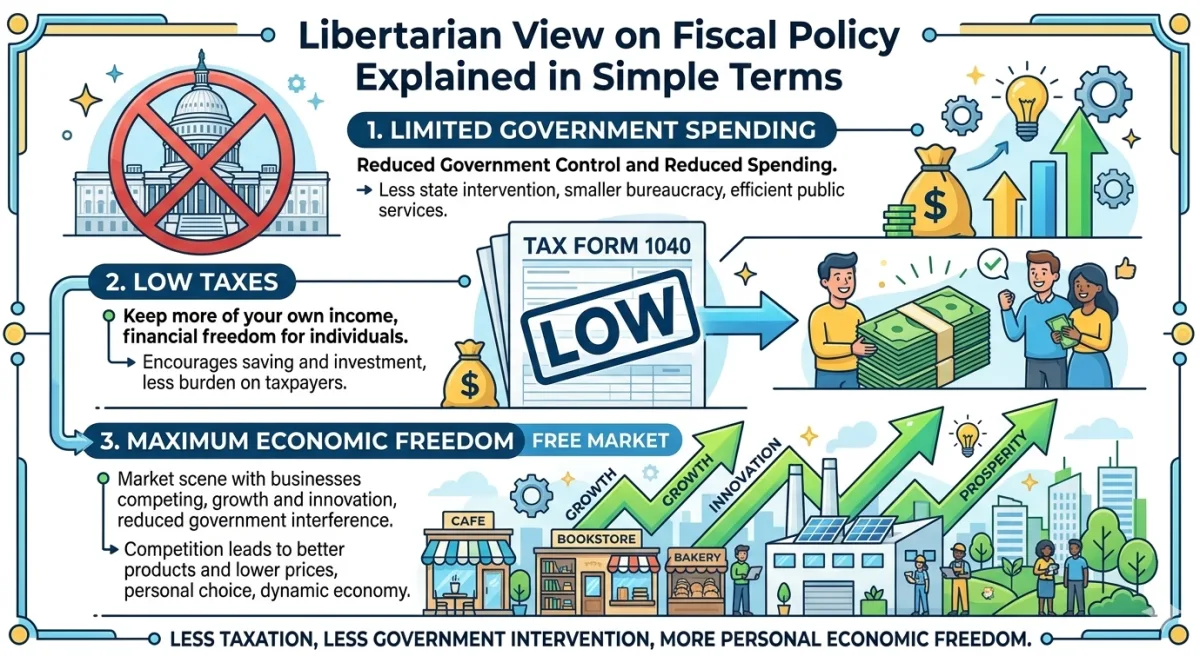



The libertarian view on fiscal policy focuses on limited government spending, low taxes, and maximum economic freedom for individuals and businesses. Libertarians believe people should control their own money instead of the government deciding how it is spent. Because of this belief, libertarians usually support smaller government budgets and fewer regulations.
In simple terms, the libertarian view on fiscal policy means the government should collect fewer taxes and spend less money. Instead, individuals and businesses should decide how to use their income. This approach aims to encourage economic growth, innovation, and personal freedom.
Many people hear about libertarian economics but feel confused about what it really means in daily life. If you have ever wondered why some economists argue for lower taxes or less government spending, this guide will help you understand their reasoning.
What Is Fiscal Policy?
Fiscal policy refers to how a government manages taxes and public spending to influence the economy. Governments use fiscal policy to support economic growth, reduce unemployment, and control inflation.
For example, during an economic recession governments may increase spending to boost demand. However during strong growth they may reduce spending or raise taxes to control inflation.
The libertarian view on fiscal policy takes a different approach. Libertarians believe the economy works best when government intervention remains minimal.
Core Principles of the Libertarian View on Fiscal Policy
The libertarian perspective focuses on several key principles. These ideas come from a strong belief in individual freedom, personal responsibility, and free markets.
Limited Government Spending
Libertarians believe governments should spend only on essential services such as national defense, courts, and law enforcement. Everything else should ideally be handled by private companies or communities.
Supporters argue that excessive government spending creates inefficiency. Large programs often require higher taxes which reduce personal income.
Low Taxes and Simple Tax Systems
Lower taxes remain one of the most important ideas in libertarian fiscal policy. Libertarians believe people should keep most of the money they earn.
Some libertarians support flat tax systems while others prefer consumption taxes. The main goal is to keep the tax system simple and fair.
Free Markets and Minimal Regulation
Another core idea is trust in free markets. Libertarians believe businesses and consumers can make better economic decisions than government officials.
Competition between companies encourages innovation and improves product quality. Therefore fewer regulations may allow markets to grow naturally.
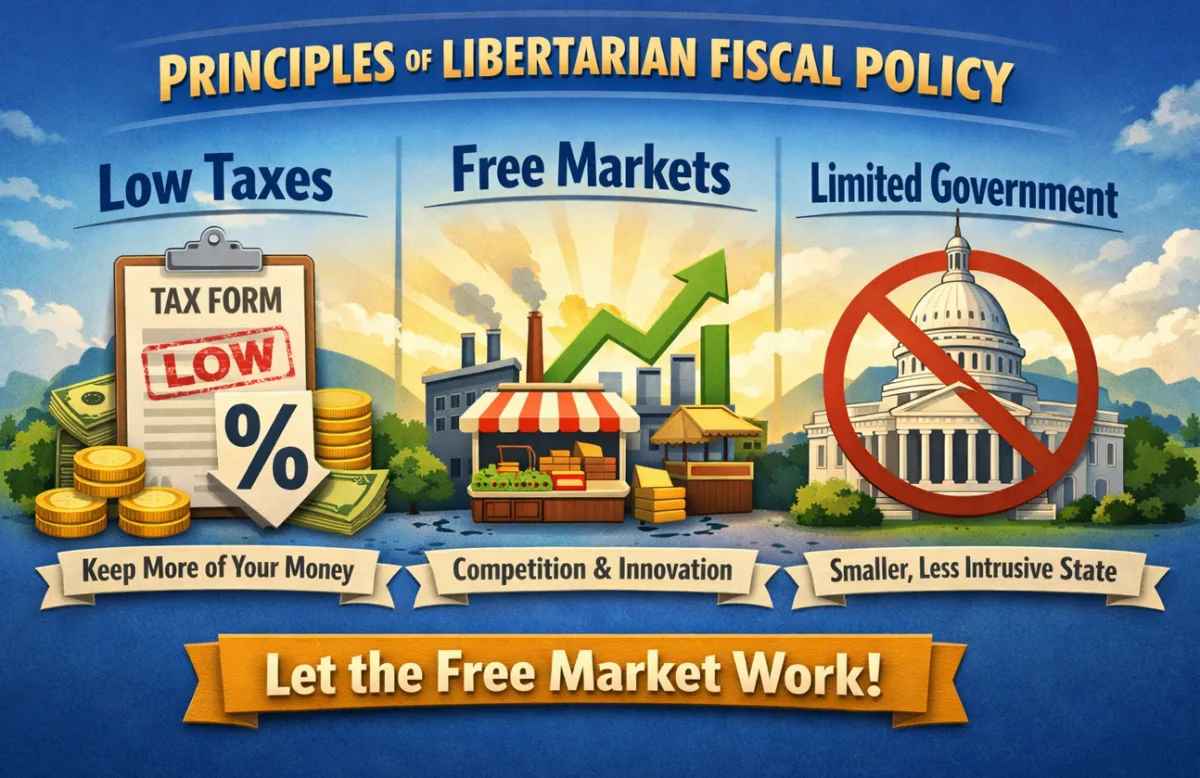
How Libertarian Fiscal Policy Differs from Other Economic Views
Understanding the libertarian view becomes easier when we compare it with other economic philosophies. Different systems treat government spending and taxation very differently.
| Economic Approach | Government Spending | Tax Policy | Role of Government |
|---|---|---|---|
| Libertarian | Very limited spending | Low taxes | Minimal economic intervention |
| Keynesian | High spending during recessions | Taxes adjusted for stability | Active economic management |
| Social Democratic | Large welfare programs | Higher progressive taxes | Strong government involvement |
This comparison shows that libertarian policies strongly emphasize economic freedom. Other systems rely more heavily on government programs.
Benefits Supporters See in Libertarian Fiscal Policy
People who support libertarian fiscal ideas believe these policies can create a stronger and more flexible economy.
Stronger Economic Growth
Lower taxes allow businesses to invest more money into expansion and innovation. When companies grow they often create new jobs.
Entrepreneurs may also feel encouraged to start new businesses when regulations remain low.
Greater Personal Freedom
Libertarian policies emphasize personal choice. People can decide how to spend their money instead of government programs controlling those funds.
This freedom may allow individuals to invest in education, businesses, or charities according to their personal priorities.
Less Government Waste
Some libertarians argue that government programs often become inefficient because of bureaucracy and administrative costs.
Reducing government spending may help minimize waste and encourage more efficient private sector solutions.
Criticism of the Libertarian Approach
Despite its supporters the libertarian view on fiscal policy also receives criticism from economists and policymakers.
Reduced Social Safety Nets
Critics worry that reducing government programs could harm vulnerable populations. Programs supporting healthcare, unemployment benefits, or housing might shrink.
Without these programs some people may struggle during economic hardship.
Infrastructure Investment Concerns
Large infrastructure projects like highways, bridges, and public transport require massive investment. Private companies may not always fund such projects.
Therefore critics argue that government involvement remains necessary in some areas.
Real World Influence of Libertarian Fiscal Ideas
Even though no country follows a purely libertarian system many governments have adopted policies inspired by libertarian ideas.
For example tax reductions, deregulation policies, and privatization efforts reflect libertarian economic thinking.
These ideas continue to influence economic debates worldwide. You can learn more about libertarian economic philosophy from trusted sources like Britannica's explanation of libertarianism.
Examples of Libertarian Fiscal Policies
To better understand libertarian fiscal thinking let us look at some policy examples.
- Reducing income tax rates for individuals
- Lower corporate taxes to encourage investment
- Simplifying national tax codes
- Privatizing certain government services
- Reducing national debt through spending cuts
These policies aim to increase economic efficiency and personal financial freedom.
Conclusion
The libertarian view on fiscal policy emphasizes economic freedom, limited government spending, and lower taxes. Supporters believe these principles create a more dynamic economy where individuals and businesses control financial decisions.
However critics argue that some government programs remain necessary to support public welfare and infrastructure. Because of these differences fiscal policy debates continue around the world.
If you want to better understand modern economic discussions learning about libertarian fiscal ideas is an excellent starting point. Exploring different economic perspectives will help you form your own informed opinion.