

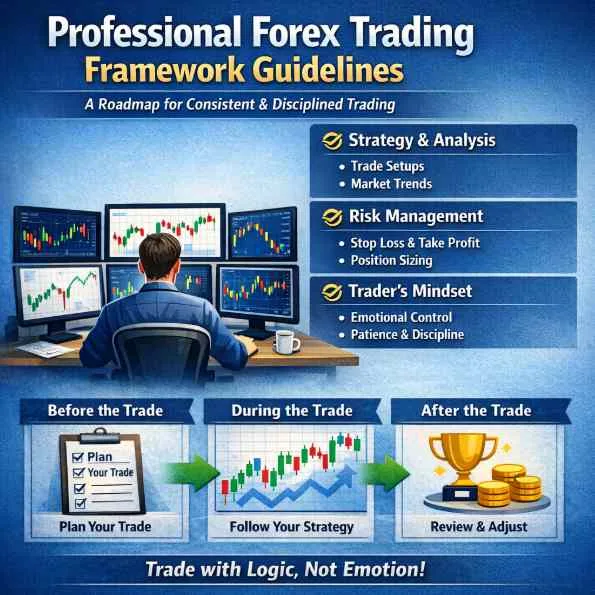



Forex trading can feel exciting at first. Prices move fast, and profits seem easy. However, many beginners fail because they trade without a plan. They rely on emotions instead of logic.
That is where professional forex trading framework guidelines come in. These guidelines act like a roadmap. They show you exactly what to do before, during, and after every trade.
Think of it like driving. You would not drive in a new city without a map. In the same way, you should not trade without a structured system. It keeps you safe and focused.
What Is a Forex Trading Framework?
A forex trading framework is a complete system that defines how you trade. It includes your strategy, risk rules, and daily habits. It also explains how you handle wins and losses.
This framework is not just about charts. It also includes your mindset and discipline. A strong framework helps you stay consistent even when the market becomes unpredictable.
For example, a professional trader knows when to enter a trade and when to stay out. They do not chase the market. Instead, they follow their system step by step.
Core Elements of Professional Forex Trading Framework Guidelines
1. Market Analysis Strategy
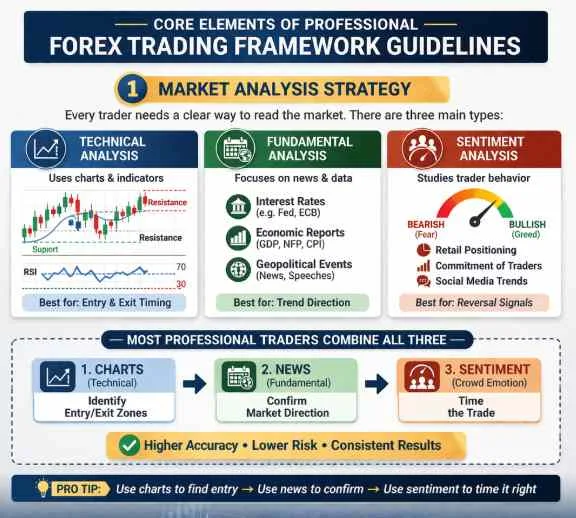
Every trader needs a clear way to read the market. This is called analysis. There are three main types, technical analysis, fundamental analysis, and sentiment analysis.
Technical analysis uses charts and indicators. Fundamental analysis looks at news and economic data. Sentiment analysis studies how traders feel about the market.
Most professionals combine these methods. For example, they may use charts to find entry points and news to confirm direction.
2. Risk Management Rules
Risk management is the most important part of trading. Without it, even a good strategy will fail. Professionals always protect their capital first.
A common rule is to risk only one to two percent of your account per trade. This keeps losses small and manageable. Over time, this helps you survive and grow.
In addition, always use stop loss and take profit levels. These tools control your trades even when you are not watching the screen.
3. Trading Plan
A trading plan is a written set of rules. It tells you when to trade, what to trade, and how to trade. This removes emotional decisions.
Your plan should include entry conditions, exit rules, and risk limits. It should also define your trading hours and preferred currency pairs.
When you follow a plan, you become consistent. Consistency is what separates beginners from professionals.
4. Trading Psychology
Many traders ignore psychology, but it plays a huge role. Fear and greed can destroy even the best strategy. Therefore, you must train your mind.
Professional traders stay calm. They accept losses as part of the process. They do not panic or overtrade after losing.
In addition, they stay patient. They wait for high quality setups instead of forcing trades. This mindset is key to long term success.
5. Trade Journaling and Review
A trading journal helps you track your performance. You record every trade, including entry, exit, and result. Over time, this shows patterns.
For example, you may notice that certain setups work better than others.
Step by Step Professional Forex Trading Process
To make things easier, here is a simple step by step framework that professionals follow daily.
| Step | Action | Purpose |
|---|---|---|
| 1 | Market Analysis | Identify trends and opportunities |
| 2 | Set Trade Plan | Define entry, exit, and risk |
| 3 | Execute Trade | Follow rules without emotion |
| 4 | Manage Trade | Adjust stop loss or take profit |
| 5 | Review Trade | Learn and improve |
This structured approach reduces mistakes. It also helps you build confidence over time.
Daily Routine of a Professional Forex Trader
Professional traders follow a routine every day. This keeps them disciplined and focused. Without a routine, trading becomes chaotic.
Morning Preparation
Start by checking economic news and calendar events. Important announcements can move the market quickly. Knowing this helps you avoid surprises.
You can check reliable updates from sources like Bloomberg Markets. This gives you a clear view of global trends.
Market Scanning
Next, scan currency pairs for trading opportunities. Look for clear patterns and strong trends. Avoid messy or unclear setups.
Focus on quality over quantity. It is better to take one good trade than five risky ones.
Execution and Monitoring
Once you find a setup, follow your plan. Enter the trade with proper risk management. Do not change your rules in the middle.
Monitor your trade calmly. Avoid checking every second. Trust your system.
End of Day Review
At the end of the day, review your trades. Note what worked and what did not. This helps you improve over time.
Common Mistakes to Avoid
Even with professional forex trading framework guidelines, mistakes can happen. However, knowing them helps you avoid costly errors.
Overtrading
Many beginners trade too often. They think more trades mean more profit. In reality, this increases risk and stress.
Instead, wait for high probability setups. Quality always beats quantity in trading.
Ignoring Risk Management
Some traders skip stop loss orders. They hope the market will turn in their favor. This often leads to big losses.
Always protect your capital. It is your most valuable asset in trading.
Emotional Trading
Trading based on emotions leads to poor decisions. Fear can make you exit too early. Greed can make you hold too long.
Follow your plan instead. Discipline is more important than prediction.
Tips to Build Your Own Forex Framework
Creating your own system takes time. However, it is worth the effort. A personalized framework fits your style and goals.
Start Simple
Do not use too many indicators. Keep your strategy simple and clear. This makes it easier to follow and improve.
Test Your Strategy
Before using real money, test your system on a demo account. This helps you understand how it works in real market conditions.
Stay Consistent
Consistency is the key to success. Follow your rules every time. Do not change your system randomly.
Keep Learning
The forex market is always changing. Therefore, keep learning new skills and strategies. This keeps you competitive.
Benefits of Following Professional Forex Trading Framework Guidelines
Using a structured framework offers many advantages. It improves both your performance and confidence.
First, it reduces emotional trading. You rely on rules instead of feelings. This leads to better decisions.
Second, it protects your capital. Proper risk management keeps losses small. Over time, this helps you grow your account.
Finally, it builds discipline. Discipline is what turns a beginner into a professional trader.
Conclusion
Professional forex trading framework guidelines are not optional. They are essential if you want to succeed in the forex market. Without them, trading becomes risky and unpredictable.
By following a structured system, you gain control over your trades. You reduce mistakes and improve your results over time. Remember, success in forex is not about luck. It is about discipline, patience, and consistency.
Start building your framework today. Take small steps, stay committed, and keep learning. With the right approach, you can trade like a professional and achieve long term success.