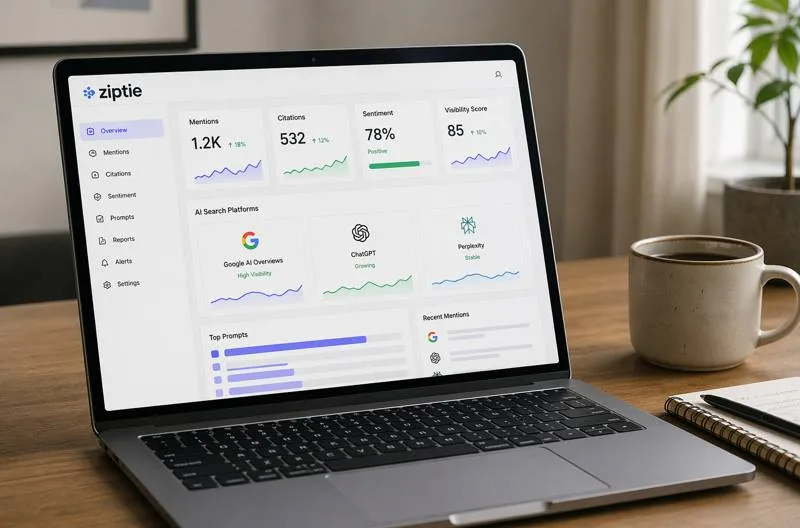

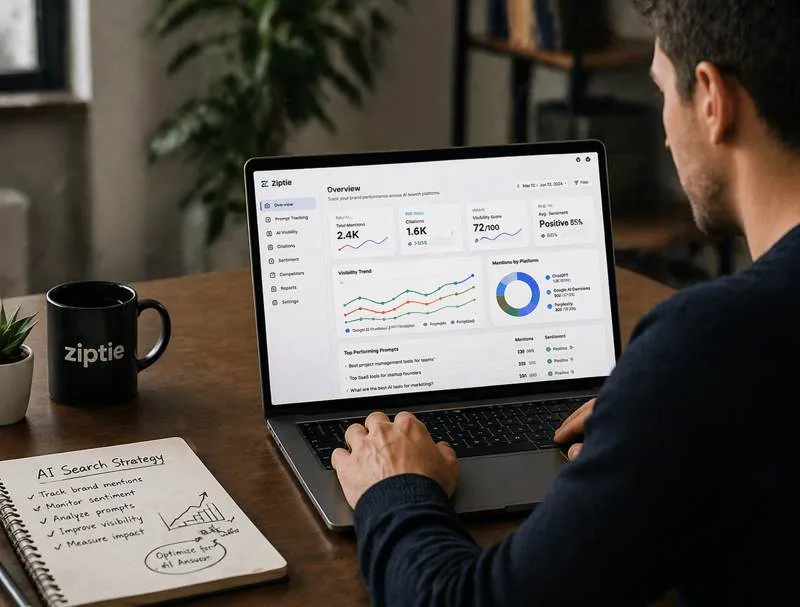
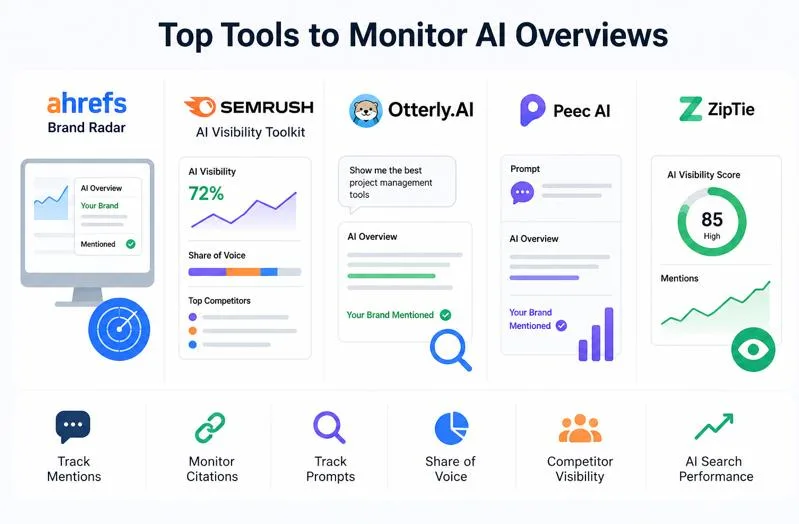
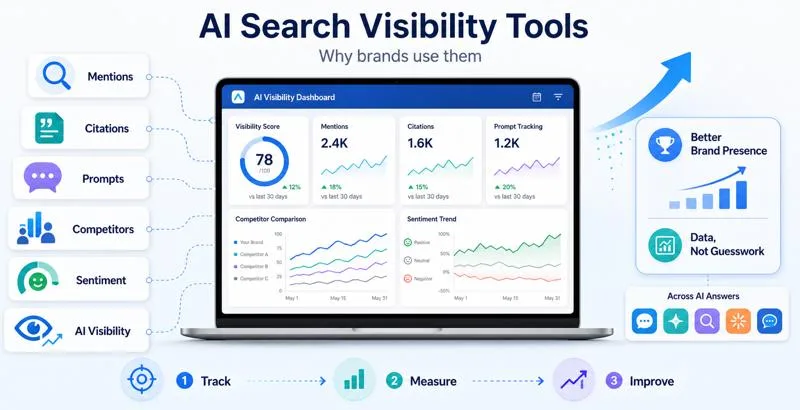
You choose Ziptie AI search performance tool when you want to see how your brand appears inside AI answers across Google AI Overviews, ChatGPT, and Perplexity. It helps you track mentions, citations, sentiment, and prompt level visibility, then turns that data into insights you can actually use to improve AI search presence.
That short answer helps, but it is not enough for a serious decision. Most marketers, founders, and content teams also want to know how the tool fits into a real workflow, what makes it different, and whether the data is useful enough to act on. This guide breaks that down in simple English.
What Ziptie AI Search Performance Tool Actually Does?
Ziptie is built for AI search visibility, not just classic search rankings. Instead of only telling you where a page ranks in Google, it focuses on whether your brand appears inside AI generated answers. That is a different kind of visibility, and it matters more now than many teams expected a year ago.
On its official site, Ziptie says it tracks visibility across Google AI Overviews, ChatGPT, and Perplexity. It also highlights practical features like relevant prompt discovery, content optimization recommendations, project level and query level tracking, citation tracking, sentiment analysis, and source attribution. Those features are what make the tool feel purpose built for AI search rather than adapted from older SEO software.
So if your team wants to understand how AI systems talk about your product, brand, or website, this is the kind of tool meant to answer that question. It is not only about traffic or ranking. It is about representation, discoverability, and influence inside AI responses.
Why Traditional SEO Tools Are Not Enough on Their Own
Traditional SEO still matters a lot. You still need strong pages, good site structure, helpful content, and authority signals. However, traditional SEO tools usually stop at rankings, backlinks, crawl data, and keyword positions. They do not always show how your brand is being surfaced inside AI generated answers.
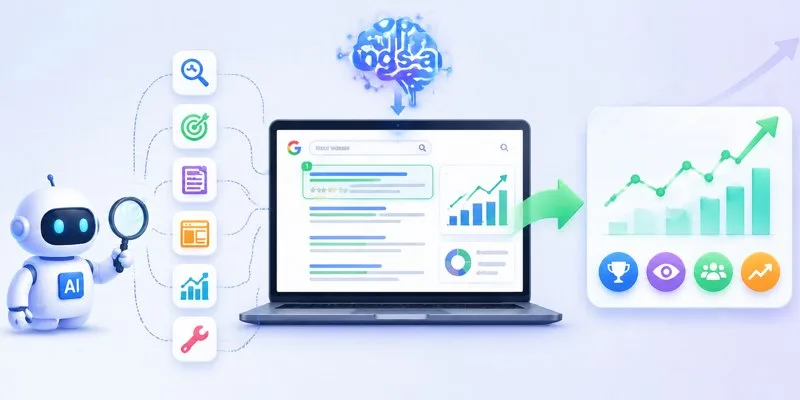
This is the gap Ziptie is designed to fill. AI search is not only about who ranks first on a results page. It is also about who gets named, who gets cited, and how the answer frames the brand in front of the user. That extra layer is hard to track manually at scale, especially across multiple AI platforms.
That is why the choice is not usually Ziptie versus SEO. The smarter comparison is Ziptie plus SEO versus SEO alone. One gives you traditional search insight, and the other shows how AI answer engines are using or ignoring your brand.
If you like beginner friendly explanations of newer AI topics, what are AI agents, a simple guide for non tech people is a natural related read. It fits well because both topics are about understanding how AI driven systems actually work.
The Real Reasons Brands Choose Ziptie
The first reason is clarity. AI search can feel invisible if you do not have a tool built for it. A brand may be doing good SEO and still not know whether ChatGPT or Google AI Overviews mention them in important prompts. Ziptie gives that missing layer of visibility.
The second reason is speed. Manual AI search checking is possible, but it is slow, messy, and hard to repeat at scale. Once you add multiple prompts, multiple platforms, multiple competitors, and multiple regions, hand checking becomes a poor use of time. Ziptie turns that into a system instead of a guessing game.
The third reason is actionability. The official site makes it clear that the platform is not only a monitoring tool. It also positions itself as an AI search intelligence and optimization platform with recommendations, success scores, and content guidance. That matters because raw data is helpful only when it points to better decisions.
Key Features That Make Ziptie Worth Considering
When people ask why choose Ziptie AI search performance tool, they usually want to know whether the feature set solves real business problems. The answer depends on your goals, but a few features stand out immediately because they connect directly to how AI search works today.
| Feature | What It Helps You See | Why It Matters |
|---|---|---|
| AI search monitoring | How your brand performs across major AI search platforms | Shows where you are visible and where you are missing |
| Mentions and citations | Whether your brand is named and your site is referenced | Measures real AI answer influence |
| Sentiment analysis | How positively or negatively your brand is described | Shows not only presence, but tone |
| Query discovery | Which prompts matter for your brand and audience | Finds opportunities you may miss manually |
| Success scores and recommendations | Which prompts or areas need work first | Helps teams prioritize faster |
This mix matters because AI search success is not one metric. A brand may be visible but not cited. It may be cited but framed badly. It may perform well on one prompt and disappear on another. Ziptie appears useful because it lets teams look at those layers together instead of in isolation.
Prompt Level Tracking Is a Bigger Deal Than It Sounds
One of the most practical reasons to choose Ziptie is prompt level tracking. The official site explains that users can view performance at the project, category, and individual query level. That is important because AI search behavior changes a lot depending on how the question is asked.
For example, a brand might show up well for broad category prompts but poorly for comparison prompts or buying intent questions. Without prompt level visibility, teams can easily miss where the real opportunity or weakness sits. That makes this feature more than a reporting detail. It becomes a strategic advantage.
It also helps teams stop making broad assumptions. Instead of saying “we are doing well in AI search,” they can say “we are strong on educational prompts, weak on comparison prompts, and nearly absent on commercial prompts.” That is the kind of insight people can actually use.
Citation and Sentiment Data Make the Insight More Useful
Another reason to choose Ziptie is that it tracks more than simple inclusion. The official FAQ says it measures citation tracking, source attribution, and sentiment analysis. This matters because a brand mention is helpful, but a cited source can be even more valuable, and the tone of the mention can change the outcome entirely.
If AI systems mention your brand but frame it weakly, that is a different problem from total invisibility. If competitors are getting cited as sources while you are not, that is also a different problem. Ziptie looks useful because it separates those realities instead of hiding them behind one visibility number.
This is where the tool can move from interesting to important. It helps teams see not only whether AI search notices them, but how AI search represents them to users.
If you are also comparing broader AI work tools, best 5 AI business tools in 2026 for productivity and growth is another natural internal read. Many people looking at Ziptie are also thinking about their wider AI tool stack.
Who Gets the Most Value From Ziptie
Ziptie makes the most sense for teams that already care about search visibility and brand discoverability. That includes SEO teams, content marketers, agencies, SaaS companies, ecommerce brands, and founders who want clearer answers about AI search presence.
It is especially useful if your audience is already using AI tools for product discovery, recommendation questions, or informational research. In those situations, getting cited or mentioned in AI answers can shape real buying behavior even before a user clicks through to a website.
On the other hand, the tool may feel too specialized if you are not yet thinking about AI search at all. If your team only wants a general site audit or simple keyword tracker, Ziptie may not be the first tool to buy. Its value is strongest when AI answer visibility is already a serious business concern.
How Ziptie Fits Into a Real Workflow

The smartest way to use Ziptie is not as a passive dashboard. It works better as part of a repeating workflow. First, you monitor the prompts that matter. Then you identify where your brand is weak, where competitors are stronger, and where trusted sources are being cited instead of you.
Next, you improve the content, the positioning, and the source presence around those weak spots. Then you measure again and see whether the visibility changes. This kind of loop is what turns AI search tracking into real business improvement.
Ziptie’s own blog explains a similar logic. It points users toward monitoring AI search results, improving presence on authoritative sources, and using data to optimize for AI search more deliberately. That is one reason the tool feels more practical than a simple report generator.
It Can Save Time for Teams That Need Repeatable Insight
One hidden reason to choose Ziptie is time. AI search tracking by hand becomes exhausting once you care about multiple prompts, multiple competitors, multiple markets, and multiple platforms. A system that collects this in one place can save a team many hours and make the reporting much more consistent.
This is especially important for agencies and in house teams that need to explain progress to clients, leaders, or other departments. A repeatable dashboard is usually easier to trust and easier to act on than a collection of screenshots and ad hoc notes.
If you care about the broader idea of improving business through better systems, professional digital solutions fits naturally here. Ziptie makes the most sense when it becomes part of a better decision making system, not just another tab.
Common Reasons Not to Choose It
A balanced review matters too. You may not need Ziptie if your brand does not yet care about AI answer visibility. You may also wait if your current search priorities are much more basic, such as fixing site issues, building foundational content, or understanding classic search performance first.
Another reason to pause is if your team expects the tool to do the optimization work for you. Ziptie can guide decisions and highlight opportunities, but it cannot replace strong content, credible sources, and a real search strategy. The tool shows the gap. Your team still has to close it.
So the honest answer is simple. Ziptie is not a universal tool for everyone. It is a focused AI search intelligence tool, and its value rises when your team is ready to act on the data it gives.
Conclusion
You choose Ziptie AI search performance tool when AI search visibility matters enough that manual checking and regular SEO reports are no longer enough. Its strongest value comes from showing where your brand appears, how it is cited, how it is framed, and which prompts deserve attention first.
If your audience is already using Google AI Overviews, ChatGPT, and Perplexity to research products or brands, then visibility inside those systems is too important to ignore. The best next step is to treat AI search like a channel you can monitor, improve, and measure. That is where a focused tool like Ziptie starts to make real sense.