

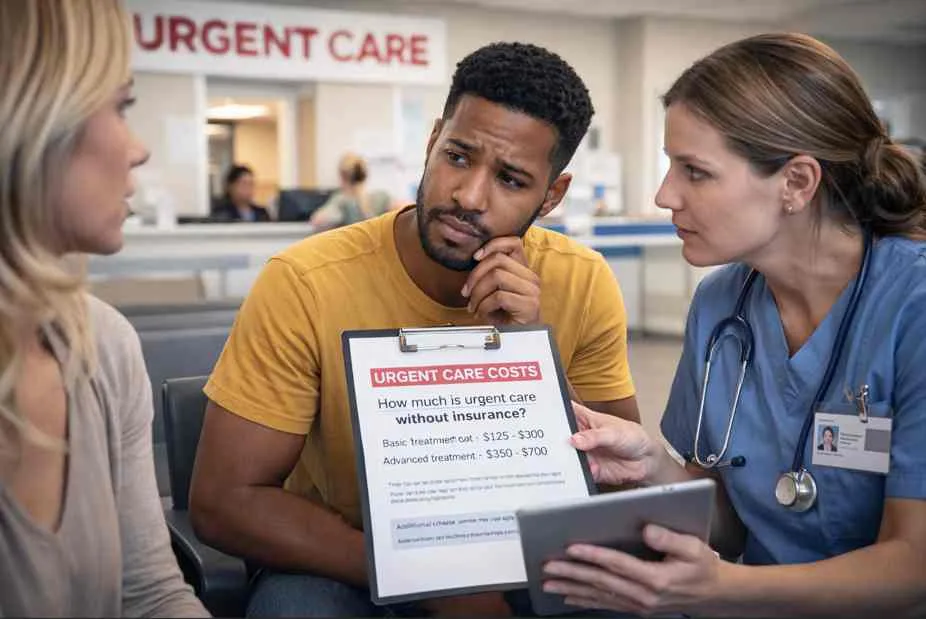



Without insurance, a basic urgent care visit often costs around $125 to $300, and many routine visits land somewhere around $150 to $200. If you need extra services like lab work, X-rays, stitches, or medications, your total can rise to $250 to $600 or more depending on the clinic and the treatment involved.
This matters because urgent care bills are not always one flat number. The visit charge is often just the starting point. What you finally pay depends on the clinic, your city, the reason for the visit, and whether you need add-ons like tests, imaging, procedures, or prescriptions.
What Urgent Care Usually Costs Without Insurance
For uninsured patients, urgent care is usually priced as a self-pay visit. GoodRx says a typical urgent care visit without insurance runs about $125 to $300, with an average around $180. A newer 2026 cost guide puts the average uninsured urgent care visit at about $150 to $280, which lines up closely with that broader range.
That means many people with basic issues like sore throat, sinus infection, mild flu symptoms, rash, pink eye, or minor sprains may end up paying somewhere in that band. However, some clinics price lower and some higher, especially in expensive metro areas or hospital-affiliated urgent care centers.
So if you want the simplest benchmark, think of uninsured urgent care as usually costing about the price of a moderate doctor visit, but often less than an emergency room by a very large margin.

Basic Visit vs Complex Visit
Not every urgent care visit costs the same. A basic visit is usually just the exam, diagnosis, and medical advice for a simple problem. A more complex visit may involve testing, wound care, splinting, breathing treatment, or other procedures. Recent 2026 and 2025 pricing references say a basic or standard uninsured urgent care visit often lands around $100 to $200, while more complex visits can rise to $200 to $350 or even $300 to $450+.
That difference matters because many people ask one simple question about urgent care cost, but the bill is often really a base visit plus whatever else happens during the appointment. A sore throat exam is one thing. A cut that needs cleaning and stitches is another.
So when clinics quote a price, it is smart to ask whether that number is only the visit fee or whether it includes likely tests and procedures too.
Typical Self-Pay Price Ranges
A helpful way to understand the cost is to break it into common ranges. Several current pricing guides line up around the same general pattern for uninsured urgent care bills.
| Visit type | Typical uninsured price | What it may include |
|---|---|---|
| Basic visit | $100 to $200 | Exam and simple diagnosis |
| Standard urgent care visit | $125 to $300 | Most common walk-in issues |
| Moderate complexity visit | $200 to $350 | Extra care or added treatment |
| Visit with labs or X-rays | $250 to $600+ | Testing, imaging, or procedures |
| Virtual urgent care | $40 to $100 | Telehealth for minor issues |
These numbers are not universal clinic fees, but they are a useful national guide for what uninsured patients commonly face.
What Can Raise the Total Bill
The final bill usually rises when the clinic adds services beyond the exam. Common add-ons include rapid strep tests, flu tests, urinalysis, urine culture, pregnancy testing, blood work, X-rays, splints, stitches, breathing treatments, and injections. The visit itself may only be part of the total.
For example, a 2026 pricing guide notes that a UTI visit may fall within the normal urgent care range if it includes a simple urinalysis, but a urine culture can add more. More complex visits with imaging or treatment procedures can rise well above the standard self-pay visit price.
So the best question is often not only “What does urgent care cost?” but also “What services are included in that price?”
Common Conditions and What You Might Pay
Routine illnesses and minor injuries are usually on the lower end of the range, especially if no testing is needed. Things like colds, sore throat, ear pain, pink eye, mild rashes, or simple medication refills may stay close to the standard self-pay visit fee.
Costs climb when the clinic needs to do more. A possible fracture may need an X-ray. A deep cut may need wound care or stitches. Urinary symptoms may need testing. Breathing issues may need in-office treatment. That is when the bill can move from the low hundreds into the mid hundreds or beyond.
So the total is less about the name urgent care and more about the amount of actual care delivered during the visit.

Urgent Care vs Emergency Room Without Insurance
This is where urgent care often looks much more affordable. Current cost guides say urgent care is often 5 to 10 times less expensive than the ER for non-life-threatening problems. One 2026 source puts a typical urgent care visit at about $150 to $280, while an ER visit may average $1,500 to $3,000+ for similar minor issues. :
That does not mean urgent care can replace the emergency room for serious problems. Chest pain, stroke symptoms, major injuries, severe breathing trouble, heavy bleeding, or signs of a true emergency still belong in the ER. But for many mild or moderate problems, urgent care is often the much cheaper option.
So if the condition is not life threatening, urgent care can often save uninsured patients a very large amount of money compared with the ER.
Urgent Care vs Primary Care Without Insurance
Primary care can sometimes be cheaper than urgent care, but not always by much. One recent source puts urgent care around $150 to $200 on average and primary care around $75 to $150. The gap is real, but it is much smaller than the gap between urgent care and the ER.
The tradeoff is speed and access. Urgent care is built for same-day walk-in treatment, especially in evenings and weekends. Primary care may cost a bit less in some cases, but it may require an appointment you cannot get quickly enough.
So urgent care often wins on convenience and timing, while primary care may win on cost for non-urgent issues if you can wait.
Telehealth Can Be the Cheapest Option
If your issue is mild and does not require hands-on examination, telehealth urgent care is often the cheapest version of urgent care. A 2026 pricing guide says virtual urgent care often runs about $40 to $100 without insurance, which is much lower than a standard in-person visit.
This can work well for issues like pink eye, mild UTI symptoms, allergies, straightforward skin concerns, cold symptoms, or medication questions, depending on the clinic and state rules. It will not help if you need an X-ray, lab test, or hands-on exam, but for the right problem it can save quite a bit.
So before going in person, it can be worth asking whether your issue could be handled through virtual urgent care instead.
Location Can Change the Price a Lot
Where you go matters. Consumer guides note that urgent care costs vary by city and clinic type, with some major metro areas charging much more than the national average. Hospital-affiliated urgent care centers may also price differently from independent urgent care clinics.
That means two clinics offering the same service may not charge the same self-pay rate. One may post transparent flat prices, while another may charge by visit complexity plus separate fees. Location, ownership model, and local competition all affect what uninsured patients end up paying.
So it is worth checking prices nearby instead of assuming all urgent care centers cost about the same.
| Factor | How it affects price |
|---|---|
| City or region | Large metro areas often cost more |
| Clinic ownership | Hospital-affiliated centers may charge more |
| Visit complexity | More treatment usually means higher cost |
| Labs or imaging | Add-on services can raise the bill sharply |
| Telehealth vs in-person | Virtual visits are often much cheaper |
Do You Usually Pay Up Front
In many self-pay situations, yes. Uninsured patients are often asked to pay at the time of service or at least pay a visit fee before being seen. Newer 2026 self-pay guides also note that many clinics require payment at the visit, though some may offer payment plans or self-pay arrangements.
This is why it is a good idea to call ahead and ask about self-pay pricing, deposits, and whether lab or imaging charges are billed immediately or added later. Some clinics are very transparent. Others give only a base visit price until they know what treatment you need.
So if cash flow is tight, asking about the payment policy before you go can save stress and surprises.
How To Pay Less Without Insurance
The first step is to ask for the self-pay or cash-pay price. Many urgent care centers offer lower rates for uninsured patients who pay directly rather than being billed through insurance. Some clinics also offer full-payment discounts or flat visit fees.
The second step is to ask what the visit includes. If you need testing, ask how much those add-ons cost before agreeing. The third step is to compare independent urgent care centers, telehealth options, and community health centers if your condition is not severe. Community clinics or sliding-scale centers may be cheaper for some patients.
So saving money often comes down to three things: compare prices, ask about self-pay discounts, and avoid paying ER prices for a problem urgent care can handle.

When Urgent Care Is Worth It Without Insurance
Urgent care is usually worth it when you need same-day care for something that is clearly not life threatening, but still should not wait several days. For uninsured patients, it often hits the middle ground between primary care and the ER on both speed and price.
If the choice is between paying $150 to $250 for urgent care and potentially $1,500 or more for an ER visit for a minor issue, urgent care usually makes far more financial sense. The exception is when the symptoms are serious enough that delaying emergency treatment would be dangerous.
So for many common non-emergency illnesses and injuries, urgent care remains one of the more practical uninsured options in U.S. healthcare.
Helpful External Resources for Better Price Checking
If you want a strong consumer-friendly starting point, GoodRx on urgent care without insurance is useful for a broad cost range and average visit benchmark. For a newer 2026 overview, Venteur’s 2026 urgent care cost guide is helpful for current visit ranges and ER comparisons.
For another recent self-pay range breakdown, Epic Health Systems on urgent care without insurance gives useful basic, moderate, and labs-plus-imaging examples.
Simple Way To Remember the Cost
If you want one easy benchmark, use this. A basic uninsured urgent care visit is often around $125 to $300, with many routine visits landing somewhere near $150 to $200. Add-ons like labs, X-rays, and procedures can push the total much higher.
That short rule is not perfect for every city or clinic, but it gives a realistic starting point. It also helps explain why asking about included services is just as important as asking about the visit fee itself.
Once you remember that, urgent care pricing becomes much less mysterious.
Conclusion
How much is urgent care without insurance. In many cases, a basic self-pay urgent care visit costs about $125 to $300, and many standard visits fall near $150 to $200. The final cost can rise into the mid hundreds or more if you need lab work, imaging, wound care, or other procedures. Urgent care is still usually much cheaper than the ER for non-life-threatening problems, which is why it remains one of the most practical uninsured care options.
The most important thing to remember is that the visit fee is only part of the story. Ask about self-pay pricing, what is included, and the cost of likely add-ons before you go when possible. That is usually the best way to avoid surprise bills.